The MCP Protocol: Why It’s Important and How to Use It in an Industrial Setting
Professionals in the industrial automation sector are increasingly being asked: “Couldn’t we integrate AI capabilities into our systems?”
Over the past two years, AI-based solutions have spread rapidly, becoming everyday tools in many personal and professional activities. Interacting with a system using natural language is now a familiar experience, and it’s only natural that those working in the industrial sector also expect to be able to take advantage of similar possibilities.
But how do you connect a data source, such as a database that stores asset measurements, to an AI model? Is it possible to create a chatbot to quickly query data from your production process?
In this article, we’ll explore what the Model Context Protocol (MCP) is, why it’s relevant to the industrial sector, and how AVEVA is integrating this technology into its products.
What is the MCP protocol used for?
The most widely used AI platforms are based on LLMs (Large Language Models), that is, large-scale language models that allow users to interact in natural language with an advanced model, which in turn has been trained on a massive amount of data, primarily from the Internet. The responses we receive are therefore based on the information learned during training.
To enable an AI application to use up-to-date, company-specific information, it must be connected to the systems that collect and manage that data. In this way, the model can base its responses on information retrieved from external sources without necessarily having to be retrained on them.
The Model Context Protocol (MCP) is an open standard designed specifically to simplify communication between AI applications and external systems.
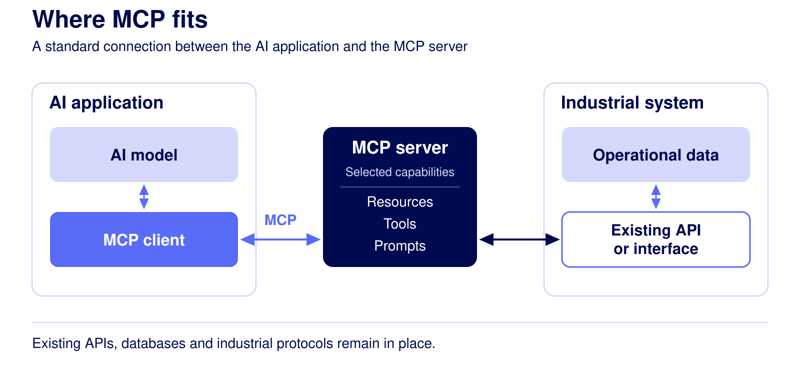
A data source, such as a historian database, anMES system, or maintenance software, can be connected to an MCP server, which exposes specific information and functionality through a standardised interface. Compatible AI applications can then utilise these capabilities without requiring specific integration with the source system each time.
For developers working with industrial technologies, MCP represents an opportunity to make OT data more accessible and facilitate the creation of new AI-based applications.
How does an MCP Server work?
The Model Context Protocol defines a standardised way for an AI application to discover and use the capabilities provided by external systems, without having to develop a specific integration for each agent or model every time.
The MCP Server is therefore designed for a specific source, so that any MCP-compatible AI engine can connect to and use it.
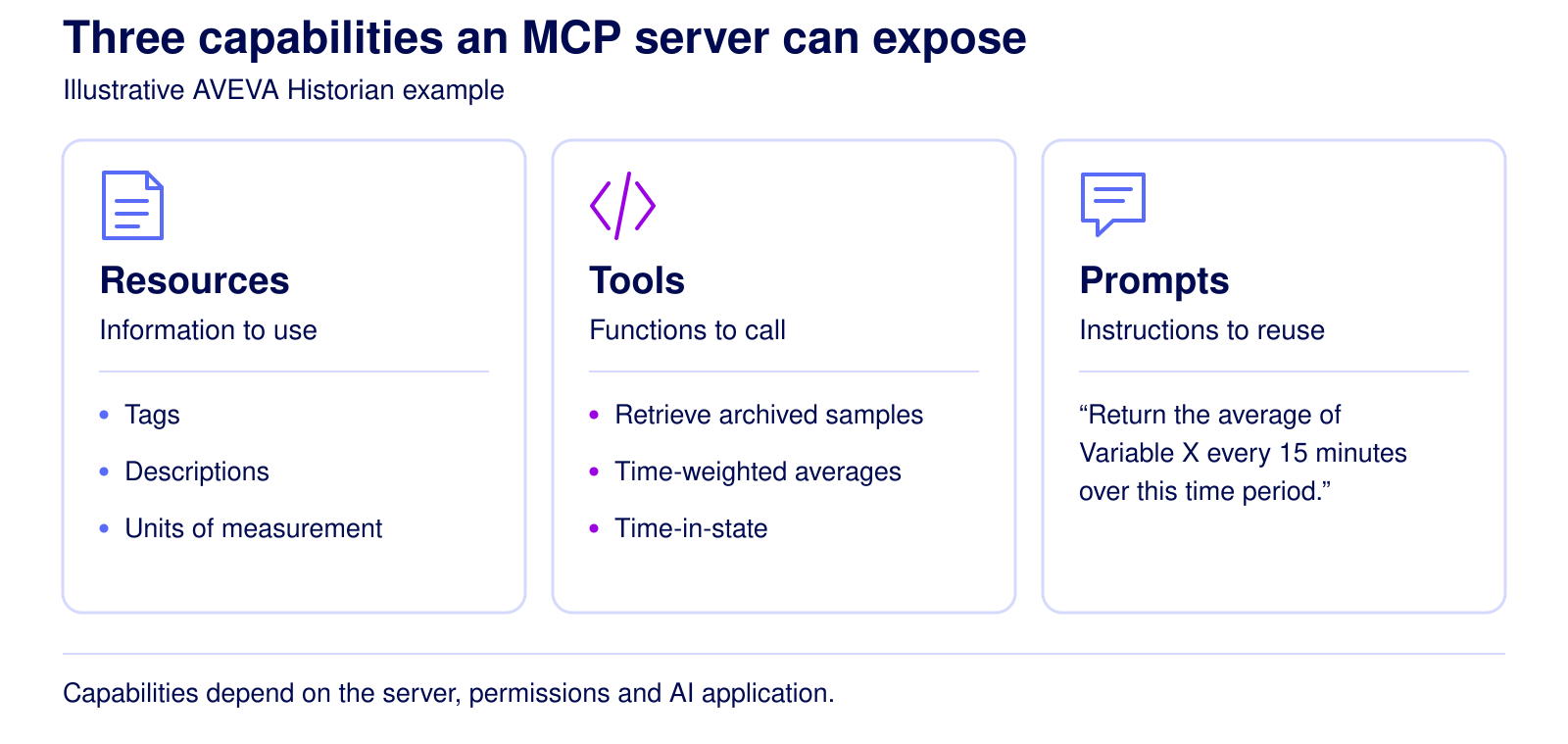
An MCP Server can expose three main categories of elements:
- Resources: the information that an AI application can access from the source.
- Tools: executable functions for querying the source or triggering actions.
- Prompts: natural language instruction templates that can be reused to leverage the Tools and Resources.
The AI application can discover the available information, select the tools relevant to the user’s request, and use them to obtain information or perform authorised operations.
The advantage is primarily architectural: instead of building a completely different integration for each AI application, developers can expose a system’s capabilities through a standardised interface, making them accessible to MCP-compatible clients.
MCP does not replace existing APIs, databases, or industry protocols. Instead, it can complement them by providing a level of integration designed for AI applications.
A Practical Example: AVEVA Historian
Let’s imagine what an MCP Server for AVEVA Historian might look like: a high-performance database dedicated to archiving and retrieving industrial process measurements.
The resources of this MCP Server would allow users to find all archived tags, along with their descriptions and units of measurement.
The Tools would be the functions to call to retrieve archived samples of a tag over a specific time interval. They could also expose some of the native analyses provided by Historian, such as the time-weighted average, the integral, or the time-in-state function of a Boolean measurement.
Prompts could be examples of instructions such as “Return the 15-minute average of variable X in this time interval,” which represents a request to use the Average retrieval mode with a 15-minute frequency.
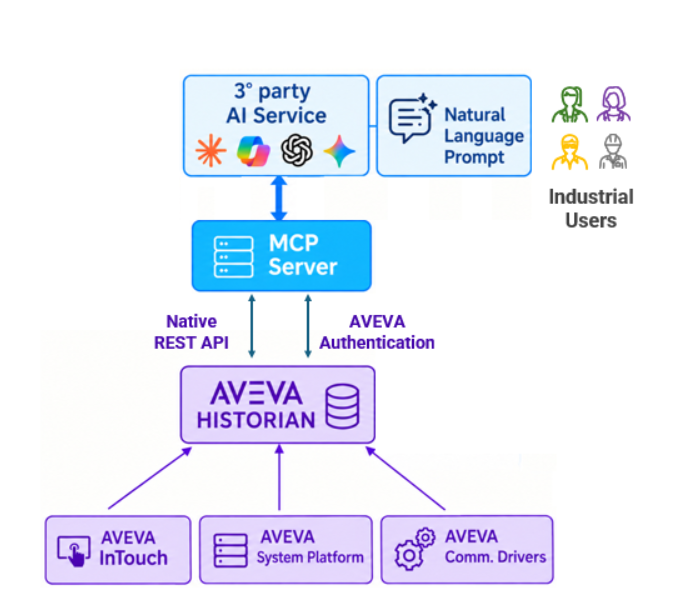
The MCP Server would then act as an intermediary between the AI application and Historian, translating the requests into operations compatible with the available interfaces, such as Historian’s APIs—and returning the results to the AI application’s MCP client.
With an MCP Server dedicated to the Historian, a user could integrate one of the AI providers compatible with MCP technology, such as ChatGPT, Claude, or Copilot. Of course, the features actually available would depend on the tools exposed by the server, the configured permissions, and the capabilities of the AI client being used.
What could I do with an MCP Server in an industrial environment?
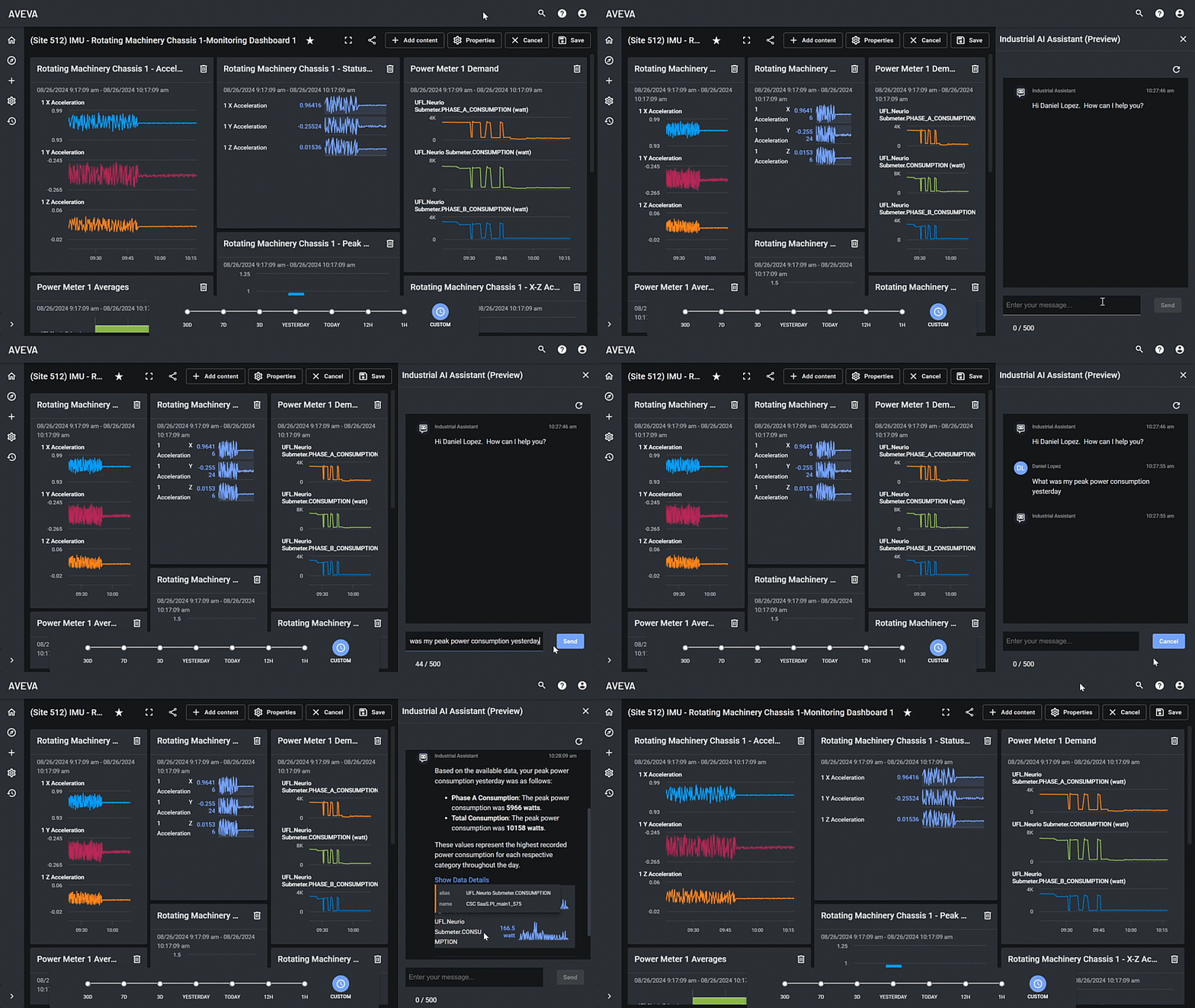
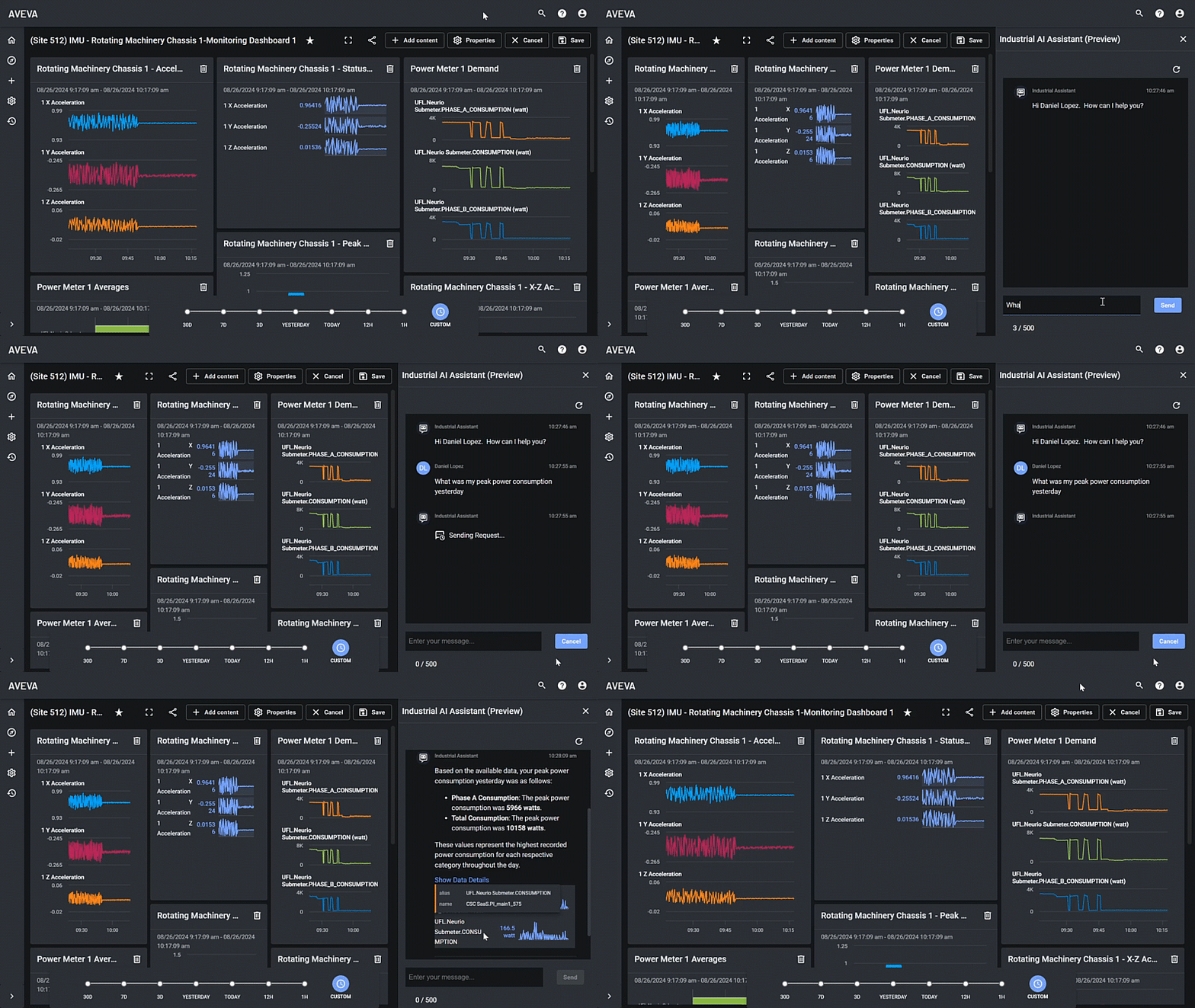
The first use case is creating chatbots to simplify and speed up data retrieval and analysis.
Returning to the Historian example, you could supplement the native tools (Historian Web Client, the Excel plug-in, and AVEVA Reports) with a conversational interface through which you can ask for information in a natural way, just as you would with a colleague in a chat:
“Historian, what was the average flow rate of the discharge pump overnight?”
“Historian, how many times did the auxiliary motor activate yesterday?”
“Historian, can you create a trend chart showing all the variables for Furnace 1 and Furnace 2 during the last shift?”
“Historian, what alarms occurred on the line in the last two hours, and which variables showed significant changes?”
The AI interprets the question, retrieves the information via the Historian MCP Server, and, based on the data received, summarises the answer in natural language.
This would make it much easier to use the data, even for operators who are less familiar with traditional analytical tools.
A second, more advanced example is the use of AI agents to perform repetitive, structured tasks with defined objectives and steps:
-
Automatic generation of an end-of-shift report.
-
Periodic analysis of archived data from a critical asset to identify possible anomalies.
-
Automatic verification of signal quality, identifying measurements that are no longer being updated due to network or sensor issues.
In this case, the MCP Server would be used to provide data to an AI engine configured to perform these tasks.
It is important to note that MCP does not automatically guarantee the accuracy of the analyses. The protocol allows the AI to access available data through the exposed tools, but the interpretation and final results provided by the AI must be verified. Applications must also be designed with the level of reliability required by the industrial context in mind.
With an MCP Server, it is possible to connect AI technologies to plant data, making analysis much simpler even for personnel less accustomed to working with historical data. In fact, this reduces the need for specific IT skills to query the data, allowing specialists to focus on analyses related to their areas of expertise.
How do you develop an MCP Server?
There are libraries, SDKs, and implementation examples that allow developers to quickly build a basic MCP Server. For those with software development skills, building an MCP Server with basic functionality is not necessarily complex. By using readily available tools, you can focus primarily on integration with the target system and on defining the tools you want to expose.
The complexity increases, however, when moving from a prototype to a solution intended for an industrial environment, where it is necessary to manage large amounts of data, permissions, security, and reliability requirements.
Are there AVEVA MCP Servers?
AVEVA has already recognised the strong potential of this technology, and the 2026 releases of its products are designed to support it through a series of new features aimed at standardising and automating the exposure of data structures and product configurations.
An MCP Server dedicated to Historian is currently being tested and is expected to be released in early 2027. This will be just the first step. Additional MCP Servers for AVEVA PI and AVEVA MES are planned for the future. Furthermore, the plan is to enable access via MCP to product configuration and development environments such as InTouch and System Platform.
Why will it be important to use the MCP Servers provided by AVEVA?
As we’ve seen, developing a custom MCP Server for a prototype doesn’t necessarily require a lot of resources. The difference, however, lies in the requirements for security, reliability, and maintainability.
The MCP Servers provided by AVEVA are designed to integrate with the security framework common to AVEVA products and follow best practices for data access. Furthermore, the MCP Servers will become features that evolve alongside the products.
If new security mechanisms or new methods of data access are introduced in a future release of Historian, the corresponding MCP Server will be updated accordingly.
If you are considering implementing an MCP Server in your architectures, you will therefore need to take into account the entire lifecycle of the integration, not just the time required to develop an initial prototype.
Conclusions
The MCP protocol expands the possibilities for using industrial data, accelerating integration with AI models.
The goal is not simply to add a chatbot to an industrial system, but to create a governed and reusable way to connect artificial intelligence capabilities to the systems that collect, organize, and make operational information available.
The MCP Server does not, on its own, solve all the challenges of industrial integration, but it offers developers a new architectural building block with which to address them.
For those working with AVEVA, the question to ask is: Which data and features from existing applications could become more useful if they were accessible, securely and in a standardised way, through an AI application as well?
This question can give rise to new opportunities to simplify project development, make industrial data more accessible, and explore smarter ways of interacting with production processes.