


Learn about the use of an industrial cloud platform, its benefits and its key role in digital transformation.
In the modern industrial automation landscape, the SCADA system is one of the most critical technology assets for ensuring operational control, production continuity and industrial safety. From discrete manufacturing to continuous processes, from utilities to energy, SCADA is the central supervisory layer upon which the digital factory is built.
Today, talking about SCADA system means talking about IT/OT integration, Industry 4.0,cyber resilience and industrial data governance, especially in the European context, where regulations, sustainability and competitiveness impose increasingly high standards.
What does SCADA mean?
Origin and definition of the term SCADA
SCADA stands for Supervisory Control And Data Acquisition. The meaning of SCADA is closely related to its function: to supervise industrial processes and acquire data from the field in a centralized and reliable manner.
In operational terms, what is a SCADA system?
It is industrial supervisory software that enables:
- Monitor plants and processes in real time
- Capture and historicize production data
- Manage alarms, events and anomalies
- Support operational and strategic decisions
Difference between SCADA, HMI and PLC
PLC (Programmable Logic Controller)
The PLC is the heart of industrial control.
It directly manages machines and processes, performing real-time deterministic logic based on signals from sensors and field devices. The PLC operates at the operational level and is designed to ensure reliability, speed and continuity even in critical industrial environments.
HMI (Human Machine Interface)
TheHMI is the local human machine interface.
It enables operators to monitor and control a single machine, line or process area. Its role is primarily operational and tactical, focused on immediate interaction with the plant, without an overall view of the production system.
SCADA system
The SCADA system represents the central supervisory level.
It aggregates data from multiple PLCs and HMIs, even those distributed over several plants or factories, providing a comprehensive and consistent view of the industrial process. A SCADA system enables:
- Monitor the entire plant in real time
- Standardize data, alarms and interfaces
- Analyze histories, performance and KPIs
- Support IT/OT integration and strategic decisions
In summary, the SCADA system does not replace PLCs and HMIs but, rather, coordinates them , enhances and transforms operational data into useful information for efficiency and industrial governance.
Why SCADA is critical in industrial automation
A modern SCADA is a strategic enabler because it enables:
- Reduce downtime and inefficiencies
- Improve quality and traceability
- Ensure operational safety
- Enable vertical and horizontal integration
Without advanced SCADA systems, it is not possible to talk seriously about Industry 4.0.
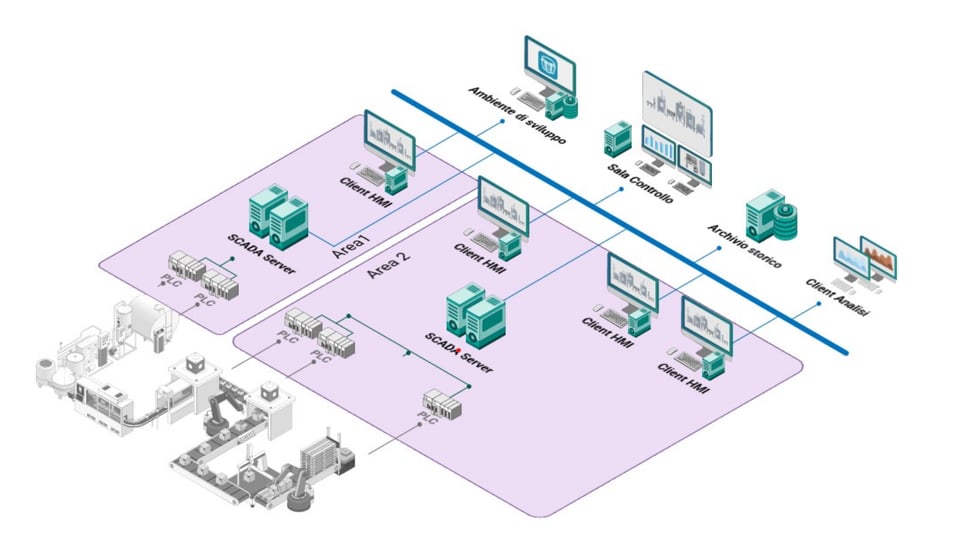
How does a SCADA system work in practice?
Understanding how a SCADA system works in practice is critical to properly assessing its impact on operational efficiency, safety, and plant scalability. A SCADA system is not a single piece of software, but a multilevel architecture that connects the physical world of manufacturing with the decision-making and management layers, transforming field data into reliable information for process control, performance monitoring, and business decision support.
The main components of a SCADA system
A SCADA system consists of several integrated technology layers, each with a specific role within the industrial architecture.
Sensors and actuators
Sensors detect physical process parameters (temperature, pressure, level, flow rate, speed), while actuators perform actions in the field. This level represents the direct point of contact between the production process and the control system.
PLC and RTU
PLCs and RTUs manage process control.
PLCs act locally in environments with stable connections, while RTUs are used in distributed settings and are capable of handling slow or intermittent connections.
They perform deterministic logic in real time, ensuring business continuity even in critical conditions, and communicate toward the SCADA supervisory layer. The PLC\RTU and SCADA relationship is central: PLC and RTU control, SCADA supervises and coordinates.
SCADA server
The SCADA system is the heart of the supervisory system.
It deals with:
- field data acquisition
- alarm and event management
- data historicization
- enforcement of security policies
- support for scada integration with IT and OT systems
This is where operational data is transformed into structured information.
Visualization clients
SCADA clients allow users to interact with the system:
- operator workstations in the control room
- web clients for remote access
- directional dashboards for KPIs and analysis
This layer makes SCADA systems accessible to different company profiles, from operator to management.
Industrial historian
Historian systems archive process data over time, enabling:
- historical analysis
- reporting
- audits and traceability
- support for continuous improvement and compliance
Industrial historians distinguish from relational database systems by:
- the ability to effectively capture large amounts of data in real time
- for the effectiveness of storing thousands of high-resolution measurements for years
- they specialize in time-series data by offering specific functions for their contextualization and analysis
Data flow and communication between devices
In SCADA systems, information flow is continuous and bidirectional:
- Data are generated from the field by sensors
- PLCs acquire and process them
- SCADA software collects and normalizes them
- Information is displayed, historized and analyzed
- Operational decisions are applied to the process via controllers
This closed loop enables real-time control, operational transparency and responsiveness, even on complex or geographically distributed plants.
SCADA architecture and common protocols
Modern SCADA systems are based on open and standardized architectures, which are fundamental to effective and secure scada integration.
Key industry protocols include:
- Modbus TCP/RTU, still widely used for simplicity and reliability
- OPC UA, an open standard for interoperability, security and scalability
- MQTT, particularly suitable for IIoT, industrial cloud and distributed architectures
- Proprietary protocols, defined by PLC vendors
An open SCADA architecture enables:
- reduce technology lock-in
- facilitate integration with existing systems
- improve cyber security
- support future plant evolution
In a European industrial environment increasingly oriented toward multi-vendor ecosystems and shared standards, a SCADA architecture based on open standards is a key element in ensuring interoperability, investment protection, and long-term evolution capability.
Why this approach is strategic
A well-designed SCADA system doesn't just "show data," it becomes:
- the central control point of the plant
- the guarantor of industrial data quality
- the basis for safety, efficiency and IT/OT integration
How does a SCADA system integrate with other industrial tools?
Integration capability is one of the elements that distinguishes a modern SCADA system from a simple supervisory platform. Today, a SCADA system must be able to securely and structurally link the factory operational level with enterprise management systems, becoming the convergence point for industrial data.
Effective scada integration is critical to ensure efficiency, business continuity and data governance, especially in European industrial settings characterized by complex, multi-site plants.
Integration with PLC and HMI
The PLC and SCADA relationship is the foundation of industrial automation.
Indeed, the SCADA system acquires and centralizes information from heterogeneous PLCs and HMIs, often from different manufacturers and technology generations.
This integration makes it possible to:
- Standardize data, alarms and interfaces, reducing operational complexity
- Reduce human errors by providing a consistent, shared view of the process
- Manage multiple plants and facilities from a single supervisory platform
In the HMI and SCADA relationship, the HMI maintains its local operational role, while SCADA provides a centralized, global view, essential for control, analysis, and continuous improvement.
Connection with MES and ERP
One of the main values of a SCADA system lies in its ability to connect the OT world with enterprise IT systems, acting as a connecting layer:
- with the MES, to monitor production, quality, traceability and indicators such as OEE
- withERP, to support planning, cost, resource management and supply chain
This vertical integration enables the transformation of field data into structured and reliable information that is critical for the European digital factory, where efficiency, regulatory compliance and sustainability are key requirements.
The importance of connectivity and industrial cyber security.
In an increasingly interconnected industrial environment, connectivity is a key element in enhancing the integration of the SCADA system with other factory tools. However, greater connectivity also implies greater exposure to risk, making industrial cyber-security a must-have requirement of any modern SCADA system.
A SCADA system must ensure reliable, continuous and structured communication between field devices, supervisory systems and IT platforms, even in complex, multi-site architectures. Thus, scada integration is not only about the ability to exchange data, but also about their protection, integrity and availability over time.
For this reason, industrial connectivity must be designed according to principles of:
- reliability and resilience, to ensure business continuity even in degraded conditions
- scalability, to support future plant evolution and the integration of new systems
- security by design, integrating OT protection mechanisms from the outset
From a SCADA security perspective, it is critical to take a structured approach that includes:
- segmentation of IT and OT networks
- access control and role management
- traceability of operations and audit trails
- protection of communications between integrated systems
Only by combining advanced industrial connectivity and OT cyber-security can SCADA systems effectively play their role as a central platform for supervision and integration, supporting digital transformation in line with European standards and the reliability, security and compliance needs of the industrial world.
What is the role of SCADA in Industry 4.0?
In the context of Industry 4.0, the SCADA system assumes a central role as a platform for connecting the physical world of manufacturing with digital tools for analysis, optimization, and decision-making.
SCADA is no longer limited to real-time supervision, but they become key enablers of industrial digital transformation, providing reliable, contextualized, and actionable data throughout the value chain.
Predictive monitoring and intelligent maintenance
One of the most relevant contributions to Industry 4.0 is the ability to enable predictive monitoring strategies and intelligent maintenance.
By continuously collecting and historicizing process data, a SCADA system enables:
- Reduce breakdowns by identifying anomalies and deviations before they result in plant downtime
- Optimize maintenance, moving from reactive or scheduled approaches to models based on actual asset conditions
- Improve plant reliability and availability by extending the life cycle of machines
In this scenario, it is clear how SCADA represents the data base on which to build advanced analysis models and more informed operational decisions.
Digital Twin and process simulation
The data generated is a key element in the development of Digital Twin and industrial process simulation models.
By integrating real data from the field with a SCADA system, it is possible:
- Simulate plant behavior under different operating conditions
- Optimize processes by testing alternative scenarios without impacting real production
- Support continuous improvement, reducing risk and time to implement changes
The Digital Twin, powered by SCADA data, thus becomes a strategic tool for increasing efficiency, quality and competitiveness, in line with the principles of Industry 4.0.
Scalability and industrial cloud
An Industry 4.0-oriented SCADA must be designed to grow over time, adapting to the evolution of the business and industrial environment. In particular, it must support:
- growth from a single plant to multi-site architectures, while maintaining consistency and standardization
- the evolution from on-premise solutions to hybrid or industrial cloud models, without compromising security and performance
This scalability enables industrial companies to initiate phased projects, protect existing investments, and prepare for new integration, analytics, and cross-plant collaboration needs.
How to protect a SCADA system from cyber risks?
Cyber-security is a central issue for all industrial companies that are facing paths of digitization and IT/OT integration. Today, all systems no longer operate in isolated environments, but are connected to enterprise networks, analytics platforms, and cloud services, significantly increasing the possibility of attack.
Ensuring industrial cyber security means protecting not only data, but also business continuity, people safety and the resilience of the industrial infrastructure.
Main OT risks and vulnerabilities
SCADA systems manage critical processes and strategic infrastructure. The main vulnerabilities in the OT domain include:
- Cyber attacks targeting industrial environments, such as ransomware and malware designed to target control systems
- Unauthorized access, often caused by shared credentials, lack of traceability or inadequate user management
- Technology obsolescence, with legacy components not designed to address current threats
- Ungoverned IT/OT convergence, exposing the SCADA system to risks typical of IT networks
These factors make it clear that OT security must be considered an integral part of SCADA system design.
How to protect a SCADA system
An effective approach to SCADA system security must be multilevel and integrated from the earliest stages of the project.
Key measures include:
- IT/OT network segmentation
Logically and physically separate control networks from enterprise networks, limiting access points and attack propagation. - Updates and patch management
Keep SCADA software, operating systems and field devices up-to-date, adopting controlled procedures to avoid impacts on production. - Authentications and Access Management
Implement robust roles, privileges and authentication mechanisms, ensuring traceability of operations and accountability of users. - Backup, redundancy and business continuity
Define disaster recovery strategies to ensure rapid recovery of the SCADA system in the event of an incident.
These practices significantly reduce risk and increase overall system resilience.
Safety standards
SCADA security must be aligned with recognized international standards:
- IEC 62443
Reference standard for security of industrial automation and control systems, specifically oriented to OT environments. - ISO 27001
Provides a framework for enterprise-wide information security management that can be integrated with OT requirements. - Purdue Model
Defines a layered architecture to separate and protect the various IT and OT functions within industrial facilities.
A SCADA system designed according to these standards is more secure, resilient, and compliant with regulations, supporting sustainable and reliable digital transformation.
The European context is then characterized by specific regulations:
- NIS 2
Applies to the most critical sectors and their supply chain. Introduces stringent requirements on risk management, incident reporting and penalties. - CRA
Imposes security requirements for related hardware and software products.
Aims to reduce vulnerabilities throughout the life cycle, with obligations for manufacturers and penalties.
Those who provide connected technology or who implement it in their facilities are therefore responsible for ensuring that cybersecurity is managed as a priority and is constantly monitored. SCADA systems because of their critical role in connecting with industrial assets must therefore be designed and implemented with the concept of secure by design according to international standards.
AVEVA's SCADA solutions.
In the industrial scada software landscape, AVEVA 's solutions set the standard for reliability, integration and security.
Factory Software is AVEVA's sole reseller for France, Germany, Italy and Switzerland and supports companies in designing secure, scalable and Industry 4.0 ready SCADA systems.
F.A.Q.
What is a SCADA system in simple words?
A SCADA system is software that allows industrial plants to be monitored, controlled and analyzed in real time from a single platform.
It collects data from machines, sensors and PLCs, transforms them into understandable information and enables operators and management to make faster, more informed decisions.
Simply put, the SCADA system is the tool that gives complete visibility into what is happening on the factory floor, improving efficiency, safety and business continuity.
What is the difference between SCADA and HMI?
The difference between HMI and SCADA is mainly in scope and level of use.
- TheHMI is a local interface, used to control and monitor a single machine or production line.
- The SCADA system, on the other hand, operates at a higher level: it centralizes data from multiple HMIs and PLCs, even across multiple plants or factories, providing a global view of the process.
In summary, the HMI is focused on local operations, while the SCADA system is oriented toward supervision, analysis, and strategic decisions.
What are the main SCADA software?
The most advanced industrial SCADA software are those that combine:
- openness to different PLCs and protocols,
- scalability from small systems to multi-site systems,
- IT/OT integration,
- industrial security by design.
Global reference solutions include AVEVA's platforms, used in thousands of industrial plants for supervision, integration and Industry 4.0 applications.
The choice of SCADA software should always be guided by requirements for integration, security and scalability over time.
How do you connect a SCADA with a PLC?
The connection between PLC and SCADA is made through industry-standard protocols, which enable secure and reliable data exchange.
The most widely used are:
- OPC UA, for interoperability and security
- Modbus TCP/RTU, for simplicity and deployment
- Other native or manufacturer-specific protocols
Proper PLC-SCADA integration allows the SCADA system to acquire real-time data, handle alarms, history information, and send supervisory commands, without interfering with deterministic PLC control.
How much does it cost to implement a SCADA system?
The cost of implementing a SCADA system varies depending on several factors:
- size and complexity of the system
- number of PLCs, signals and users
- level of integration with MES, ERP or cloud
- requirements for scada security and redundancy
An advantage of modern SCADA systems is the ability to take a scalable, modular approach: one can start with a limited project and grow over time, protecting the initial investment and adapting it to future needs.
Conclusion
In today's industrial environment, SCADA is no longer just a supervisory tool, but a strategic element for the competitiveness and sustainability of industrial companies. From the collection of field data to their transformation into useful information, SCADA systems are the connection point between production processes, people and digital systems.
We have seen how these systems play a key role in industrial automation, in the integration of PLCs, HMIs, MESs and ERPs, and how they are key to enablingIndustry 4.0 paradigms, from predictive maintenance to Digital Twin to scalable architectures and the industrial cloud. At the same time, scada security emerges as an indispensable requirement to ensure business continuity, protection of know-how and compliance with European regulations.
Choosing and designing a SCADA system therefore means making a long-term strategic choice: an investment that must be open, secure, scalable and integrable, capable of evolving with the company and its business needs.
Relying on proven solutions and partners with deep industry knowledge enables SCADA software to become a true enabler of efficiency, innovation and resilience.






![[Interview] How does AVEVA support the cosmetics and pharmaceutical industries in their digitalization?](https://on.factorysoftware.com/hs-fs/hubfs/FSO/Blog_2024/ENG/digital-transformation-life-sciences.jpg?width=680&height=460&name=digital-transformation-life-sciences.jpg)