.jpg?width=740&height=416&name=BANNER%20POST%20%20EMAIL%20(8).jpg)
The rapid technological advances of recent years in the field of Artificial Intelligence may lead us to believe that there is a type of AI capable of answering everything—or almost everything.
Want to increase the availability of your systems? Implement predictive maintenance.
Want to anticipate a potential failure? Use machine learning.
Want to increase the productivity of a production line? Create a Digital Twin.
Not sure where to start? Ask the AI.
The effectiveness of today’s AI engines is undeniable. We’re able to obtain increasingly accurate answers, analyses, and predictions in an extremely short amount of time.
Yet, when it comes to industrial AI applications, the situation is more complex. Despite growing interest and numerous successfully completed Proofs of Concept (PoCs), many solutions still struggle to gain traction and become established within companies.
The first obstacle, now evident, concerns the starting point: to obtain reliable results ,a high-quality, extensive, structured, and appropriately contextualizeddatabaseis needed on which to train the algorithms.
But that is not the only challenge.
Even a successful PoC, in fact, does not always translate into a full-fledged industrial project. The problem lies not only in the definition and accuracy of the model, but above all in the ability to turn a prediction into a decision and a decision into concrete action.
And it is precisely in this transition that a fundamental part of AI’s value in industry comes into play.
- How can an AI solution be made truly operational in day-to-day operations?
- Does AI really have all the answers?
These are precisely the two questions at the heart of our article.
To answer them, we’ll follow Ignazio, a young maintenance technician, during his work shift, closely observing situations and decisions in which AI can be a valuable aid—but can also reveal its limitations.
What does AI detect using data?
Ignazio is a young member of the maintenance team, and he’s on duty tonight.
His company has successfully implemented an AI model capable of predicting the risk of failure for some of its most critical assets.
It’s 2:30 a.m. when Ignazio receives a notification: the algorithm is flagging a high probability of downtime in the next three hours: Asset 1 – High Anomaly Score.
Ignazio logs into the user interface and identifies the details of the at-risk asset. The AI-based tool highlights several metrics that are contributing to the highAnomaly Score. The algorithm has detected that, in the past, operating conditions similar to the current ones have very often led to an asset shutdown within 3–5 hours.
“So, what do we do now?”
The tool shows him the metrics that caused the deviation: pressure, the pump’s current draw, and vibration levels. Ignazio reviews the data, but the question remains.
The AI was able to detect a situation that, in the past, has been a precursor to a shutdown. It did so by quantifyingthe Anomaly Score—that is, the measure of the deviation between the asset’s ideal behavior and its current operating conditions.
It also provided a time-based forecast, estimating when anomalous conditions such as those detected might lead to a problem, based on similar situations observed previously.
Finally, it identified the metrics that contribute most, statistically speaking, to the anomalous condition: pressure, current draw, and vibrations.
All of this is extremely useful. But there’s one key point: the AI provided a predictive analysis, but it didn’t provide a solution. It told Ignazio what’s happening and what might happen. It didn’t tell him what to do.
Read also: When conversational AI and digital collaboration transform industrial maintenance—even at 3 a.m.
How should one respond to an alert generated by AI?
At this point, Ignazio decides to conduct a visual inspection at the machine.
Before heading down to the shop floor, he checks on his computer to see if there’s an inspection procedure in the folder shared with the maintenance team regarding pressure or vibration issues—one that can guide him in checking all aspects of the machine, which he’s still not very familiar with. He also uses the maintenance tool to check what the most recent maintenance activities performed on the asset were.
The result is interesting but not conclusive: Ignazio finds an inspection procedure in PDF format, but realizes it refers to the old version of the machine, prior to the revamp.
The maintenance history also shows that, over the past two months, inspections were conducted weekly, with no anomalies detected.
However, two months earlier, a brief note had been recorded: “Asset 2 – AI anomaly alert regarding vibrations and current – motor shaft lubricated.”
Ignazio reflects: “Am I in the same situation as two months ago with the sister machine? Will lubricating it again be enough this time?”
The AI provided a powerful and replicable analysis on similar assets, offering an effective tool for identifying and interpreting abnormal conditions. But even in this case, a significant limitation emerges.
There is often a missing link between the machine’s digital world—composed of sensors, data, and mathematical models—and the physical, mechanical world—composed of gears, seals, bearings, shafts, and drive belts.
AI can recognize a pattern and indicate where to look. But to understand what is actually happening to the machine and what action is needed, a connection to knowledge of the physical world is still required.
You may also be interested in: How Generative AI Is Transforming Access to Industrial Data with the AI Assistant CONNECT
How can AI provide a solution to a problem?
Ignazio, a young maintenance technician accustomed to using digital tools for nearly every aspect of his daily life, is frustrated: he can’t quickly find an answer or advice to help him solve the problem.
Anomaly Scores, correlations between measurements, and statistical models aren’t exactly his forte.
The AI flagged a potential problemfor him , but it failed to link it to possible solutions.
Ignazio wonders:
- Should I adjust the setpoints that affect pressure?
- Should I slow down the cycle times?
- Should I physically intervene on the machine?
This is precisely where the missing link comes into play.
To enable AI to provide more precise guidance on “what to do,” it is necessary to track people’s actions and correlate them with the events that triggered them.
To make an AI tool truly operational, therefore, it’s not enough to simply record the anomaly: it’s also essential to preserve the path that led from the detection of the problem to its resolution.
Given a specific Anomaly Score, it’s necessary to be able to reconstruct which analyses were performed, which checks were carried out, and which corrective actions were taken.
A comprehensive failure history—one that includes symptoms, measurements, diagnoses, and corrective actions—enables AI to associate the current anomalous situation with situations already encountered in the past and to suggest the most likely corrective action.
But that’s not all.
That same history can help identify any “false positives” in the AI model, highlighting cases where a specific anomaly did not result in the expected failure.
In this way, the experience accumulated by people becomes an integral part of the system, and the AI is no longer limited to saying “there might be a problem, ” but can begin to suggest “this is what has worked in similar situations.”
This marks the transition frompredictive AI to operational AI.
How can an AI solution be implemented in day-to-day operations?
Ignazio heads down to the production floor and decides to ask the machine operator if he’s noticed anything unusual.
“Everything’s been fine so far.”
He then decides to perform a visual inspection of the machine, following what he learned during training. During the check , he notices a slight drip beneath the discharge pump. He asks the operator again to find out how long it’s been there.
“I’m just noticing it now, too. It must have just started. It seems like a minor issue—it can happen sometimes. But be careful: if the leak gets worse, it could cause a drop in pressure and trigger an automatic shutdown of the machine. It’s happened before, and the problem was fixed by replacing the gasket.”
Ignazio begins to piece together the information:
- about 30 minutes ago ,an Anomaly Warningwas triggered , with an estimated risk of shutdown within the next 3 hours;
- among the variables contributing to the anomaly is the flow rate;
- a driphas recently appeared beneath the discharge pump;
- the operator’s experience indicates that the leak is still minimal, but that, if it increases, it could cause a shutdown;
- a possible solution involves inspecting and, if necessary, replacing the gasket.
At this point, Ignazio faces a decision that the AI cannot make for him: should he request a production shutdown to replace the gasket or, at the very least, to conduct a more thorough inspection?
And this raises new questions:
Who should make this decision?
How can the intervention be scheduled to minimize the impact on production?
Paradoxically, Ignazio would almost have preferred not to have any AI tool at all and to receive a call only when the problem had become evident—and, perhaps, when the solution was already clear. But this is precisely the paradox of predictive maintenance.
Deciding in the face of an obvious, full-blownproblem can be easier than making a decision when you have only a suspicion, an intuition, or—in the case of AI—a prediction generated by a model.
The problem is that waiting for the failure to become evident often means taking action only after the damage has already been done.
Reactive measures, in fact, come at a higher cost, both in terms of machine downtime and their impact on production.
The real challenge, therefore, is not just predicting a problem, but being able to make the best decision at the right time by combining data, AI, human expertise, and knowledge of the production process.
Read more: How will AI accelerate the industry’s sustainable transition?
Does AI have all the answers?
Ignazio’s experience highlights a potential limitation of AI in industrial implementations: the physical and electromechanical context of assets is not always available in digital format.
An AI model can provide an accurate prediction, but it may lack all the contextual information needed to turn it into a precise and truly useful recommendation for those operating the machine.
A pressure anomaly, for example, may be caused by a worn gasket, but it could also result from a variation in the density of raw materials or the selection of a specific set point.
For this reason, industrial AI cannot rely solely on data from sensors.
To be truly effective, it must be able to draw on the operational context, process knowledge, and the experience gained by people, through tools capable of collecting, structuring, and making this information available as well.
Human experience, therefore, is not something destined to be replaced by AI, but a fundamental component for complementing and making its capabilities truly operational.
The true value of industrial AI emerges when data, artificial intelligence, and human experience work together.
What needs to be paired with AI to make it truly effective?
The example just described highlights situations that are far from rare in the industrial sector: fragmented or outdated information, insufficient communication among people, and difficulties in setting priorities when it is necessary to modify the production schedule.
Implementing an AI solution starts with data from sensors, which is essential for understanding how an asset or a production process behaves. However, this data must be contextualized within the operational environment, the actions taken by people, and the experience gained on the ground.
And this is where some fundamental questions arise:
- Where are maintenance activities tracked, and at what level of detail?
- How can an operator report an abnormal situation, even when it appears to have no immediate impact?
- How can they access documentation and procedures that are always up to date?
- How can an operator verify the impact of a maintenance activity on operational planning?
- Where are AI alerts recorded, along with their accuracy and the effects they’ve produced?
The AI is capable of answering the questions it has been trained to address. However, in an industrial setting, many of the answers needed to make a decision lie within the operational context, in people’s experience, and in the physical environment of the factory —and are not yet available in digital format.
The success of an AI implementation therefore also depends on the ability to operationalise, at various levels of the organisation, the consequences of an anomaly alert.
Without integration into people’s daily routines, AI risks being perceived as an alien element and, in some cases, even as a nuisance: yet another system that flags problems without providing the tools needed to address them.
From Prediction to Action
AI is destined to become an increasingly important component in the application architectures of the factory of the future. But its success will not depend solely on the quality of the model or its ability to make accurate predictions.
It will depend on its integration with the entire factory ecosystem.
The critical transition from a proof of concept (PoC) to a truly successful solution depends on the digital maturity of the environment in which AI is implemented: from the quality and availability of data, to the ability to standardise and digitise procedures, to the capacity to capture people’s experiences and adjust the production plan based on the decisions made.
Because in industry, predicting a problem is only the first step. The real value arises when that prediction can become a decision and, ultimately, an action.
How do AVEVA solutions contribute to AI implementation?
Within AVEVA’s portfolio, AI is part of an ecosystem of industrial solutions that guide and accelerate its integration into day-to-day operations.
Through the data acquisition platforms in the Monitoring & Control portfolio, sensor data is continuously collected by controllers and made available to all staff via cross-platform user interfaces.
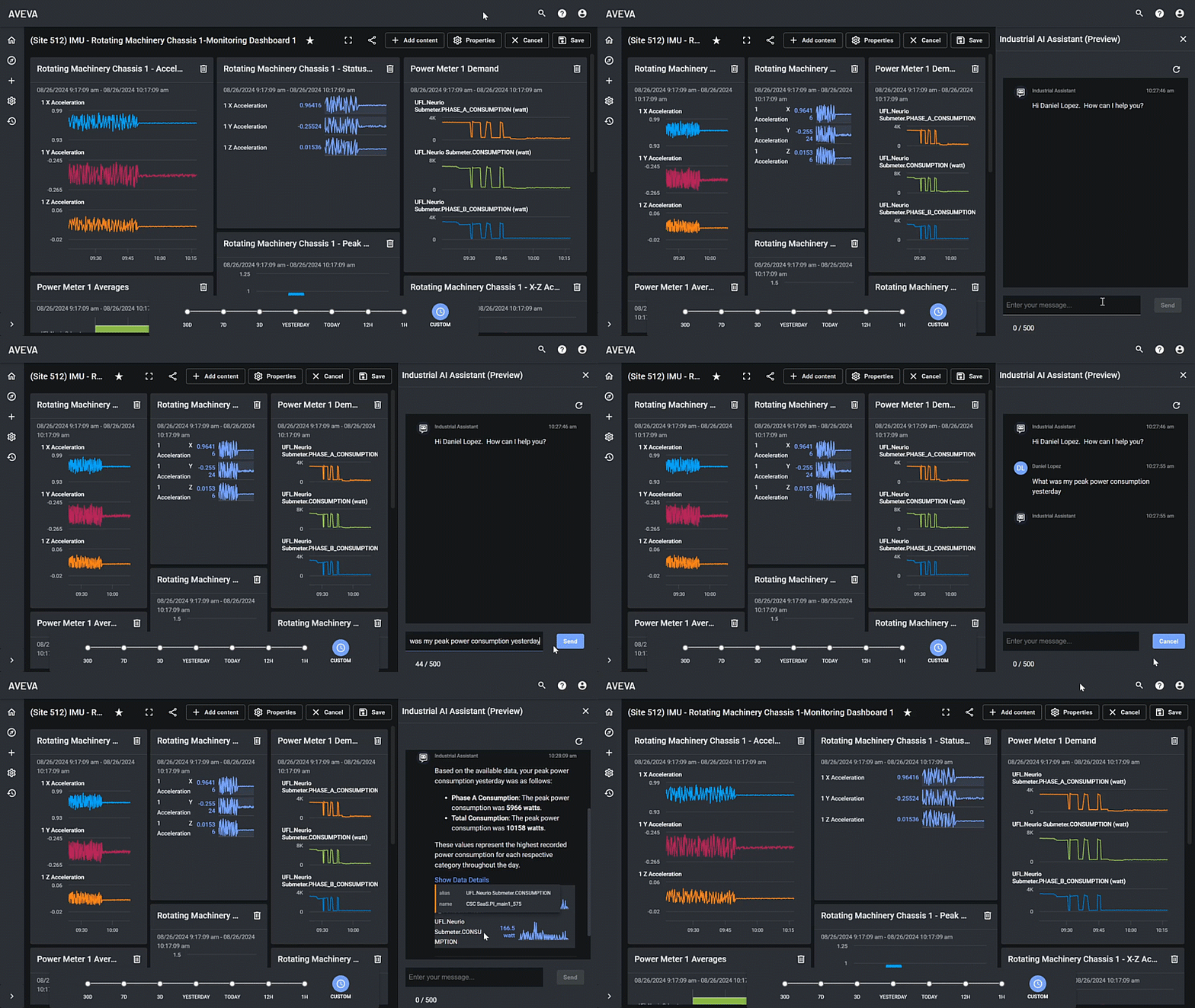
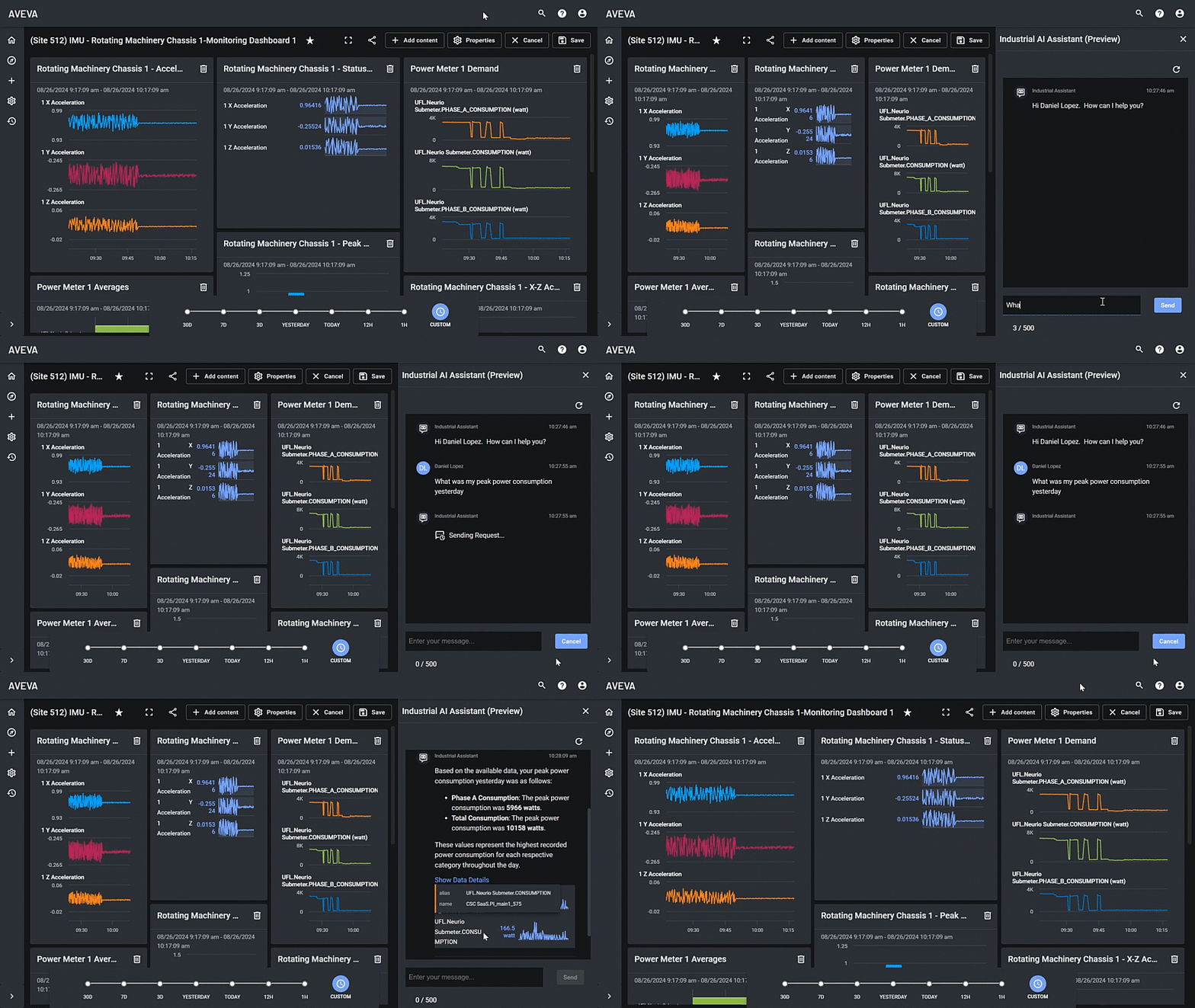
Thanks to solutions such as AVEVA Historian and AVEVA PI, data is archived at high resolution, correlated with the operational context, and, where necessary, filtered and optimized for use by analytics or reporting solutions. All of this effectively becomes the indispensable source for training models. Not only that, but thanks to solutions such as the AI Assistant—part of CONNECT—staff can perform searches and analyses on the data using natural language, simplifying and facilitating access to the data.
AVEVA Advanced Analytics is the industrial AI engine that offers a suite of models for industrial use cases, configurable to fit your specific production environment. But AVEVA Advanced Analytics is much more than an AI engine; it includes user features to track actions taken, share decisions, and measure results. This is the crucial phase known as “Operationalise,” which supports industrial operators in the critical transition from proof of concept (PoC) to an operational solution.
To support this crucial phase, AVEVA Teamwork is also available, enabling the sharing of all manual activities and the digitization of forms, procedures, and training.
AVEVA’s offering goes even further, including the MES platform that enables more comprehensive management and tracking of all production phases and enriches the data repository on which the AI operates. Finally, through the PlanetTogether scheduler, AVEVA supports detailed planning of activities and resource utilisation, and thanks to “What-If” analysis capabilities, rescheduling activities in the event of unforeseen circumstances is faster and more effective.
With AVEVA, you choose a portfolio of solutions that support operators in their daily tasks, ensuring simplified access to information. Not only that, but with AVEVA, you have tools to enhance the employee experience and correlate digital data with the physical actions that define the industrial environment.
.jpg?width=680&height=460&name=BANNER%20POST%20%20EMAIL%20(8).jpg)